
Strength Training at home works, but only when you stop treating it like random workouts and start treating it like a simple system: a few good movements, done consistently, progressed slowly, and recovered well.
If you’ve ever searched for a “home strength plan” and left more overwhelmed than motivated, you’re not alone. Most people don’t fail because they lack willpower, they fail because they don’t know what to do on Monday, how hard to push, and how to tell if it’s working.
This guide lays out the fundamentals in plain English: what matters most, how to choose exercises, how to build a weekly routine, and how to progress without burning out or tweaking a shoulder. You’ll also get a quick self-check and a practical starter plan.
What “strength training” really means at home
At its core, strength training is practicing movements against resistance so your muscles and nervous system adapt. The resistance can come from dumbbells, bands, a kettlebell, your bodyweight, or even a backpack with books.
According to the Centers for Disease Control and Prevention (CDC), adults benefit from muscle-strengthening activities on 2 or more days per week, working major muscle groups. That’s a baseline target, not a magic number.
The home version gets tricky because “light” can stay light forever if you don’t track and progress. So the fundamentals you want are:
- Movement patterns (push, pull, squat, hinge, carry, core)
- Consistency (repeat the same staples long enough to improve)
- Progressive overload (slowly increase challenge over time)
- Recovery (sleep, rest days, manageable volume)
Why people stall (and what usually fixes it)
Most home programs stall for predictable reasons. The fixes are not glamorous, but they work in many cases.
Common stall points
- No progression plan: you repeat the same weight and reps for months, then wonder why nothing changes.
- Too many exercises: you try 12 moves per workout, rush through, and never master anything.
- Intensity mismatch: always “easy” because you’re cautious, or always “all-out” because you’re impatient.
- Poor exercise balance: lots of pushing (push-ups) but not enough pulling (rows), leading to cranky shoulders.
- Inconsistent schedule: random days make it hard to build momentum and measure progress.
What fixes it: pick 4–6 core lifts, repeat them for 4–8 weeks, track sets and reps, and progress one small step at a time.
Quick self-check: what kind of home trainee are you?
Before you copy someone else’s plan, do a quick honesty check. Your “best” plan is the one you can repeat next week.
- If you’re brand new: you need simple technique cues, full-body sessions, and conservative effort.
- If you’ve trained before: you likely need structure and progression more than new exercises.
- If you feel pain (not normal muscle burn): you may need exercise swaps and, in some situations, a clinician’s input.
- If time is your constraint: 25–35 minutes, 3 days/week can still drive results with good exercise choices.
Also ask: do you have equipment, or do you need a bodyweight-only approach? Your answer changes exercise selection, not the fundamentals.
Equipment: what helps most (and what you can skip)
You can do Strength Training with almost nothing, but a couple small purchases can make progression much easier and reduce repetitive strain from endless high-rep bodyweight work.
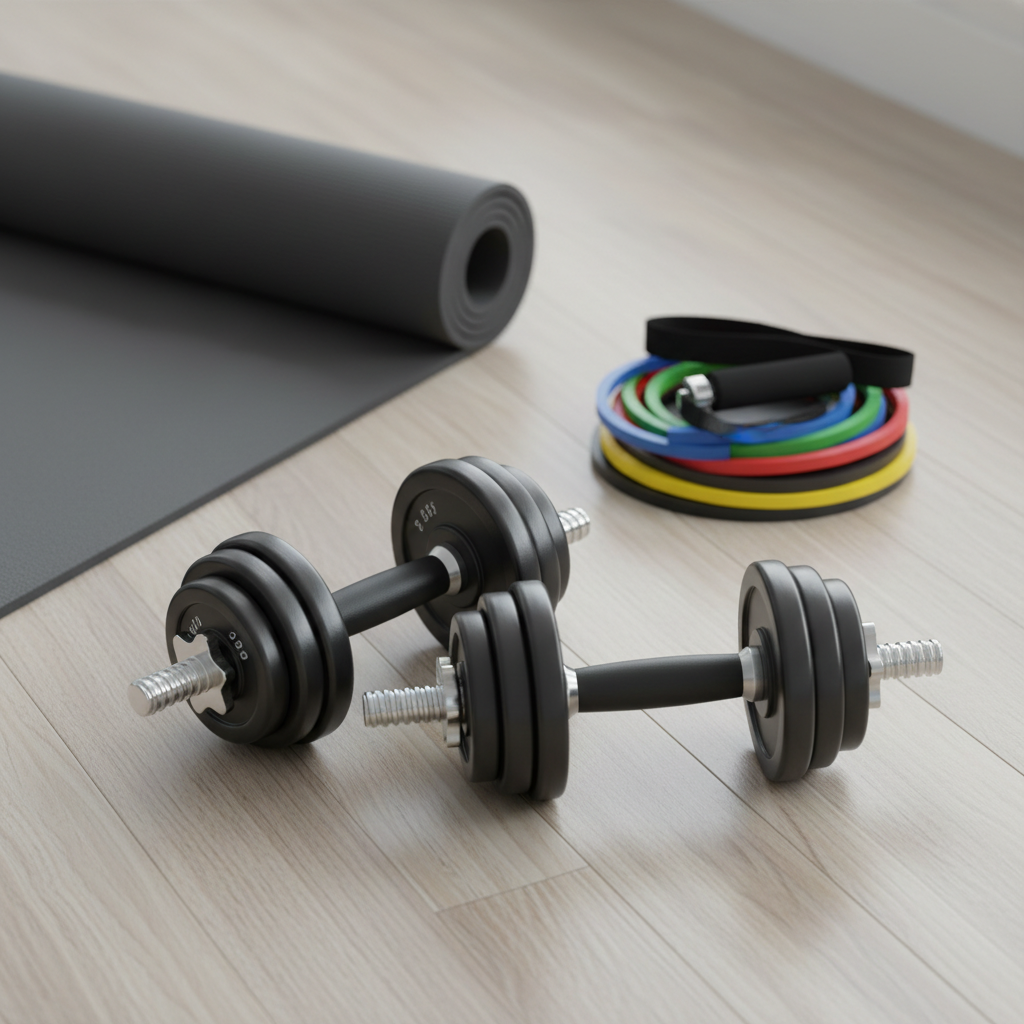
High-value basics (most homes)
- Adjustable dumbbells or a couple fixed pairs
- Resistance bands (loop + long bands) and a door anchor
- A stable chair/bench substitute (for step-ups, split squats, incline push-ups)
- Pull option: doorway pull-up bar, rings, or bands for rows
Nice-to-have
- Kettlebell for hinges and carries
- Weight vest for progressive bodyweight work
- Yoga blocks/ab wheel if your core training feels stale
What to skip early: fancy gadgets that don’t solve progression. If you can’t add reps, sets, load, or difficulty, you’ll outgrow the tool fast.
The home strength exercise menu (pick staples, not everything)
A clean routine covers major movement patterns. You don’t need dozens of exercises, you need a few that fit your body and your setup.
Core patterns and strong home options
- Squat: goblet squat, split squat, step-up, sit-to-stand
- Hinge: Romanian deadlift with dumbbells, hip hinge with band, hip thrust/glute bridge
- Push: push-up (incline if needed), dumbbell floor press, overhead press
- Pull: one-arm dumbbell row, band row, assisted pull-up
- Carry: farmer carry with dumbbells, suitcase carry (one side)
- Core: dead bug, side plank, Pallof press (band), slow mountain climbers
Form note that saves a lot of people: if your joints feel cranky, reduce range of motion, slow the tempo, and choose a variation that feels stable. If pain persists, it’s smart to consult a qualified professional.
How to build a simple weekly plan (and actually stick to it)
For most people training at home, a 3-day full-body plan is the sweet spot: enough frequency to improve, enough recovery to stay consistent.
Starter schedule (3 days/week)
- Day A: squat + push + pull + core
- Day B: hinge + push + pull + carry
- Day A: repeat with small progression
Keep each session to 4–6 exercises. That’s it. Warm up briefly, then do your work sets with focus.
Suggested sets and reps (general)
- Main lifts: 3–4 sets of 6–12 reps
- Accessory/core: 2–3 sets of 8–15 reps or timed holds
- Rest: 60–120 seconds, longer if you need to keep form clean
According to the American College of Sports Medicine (ACSM), resistance training programs commonly use multiple sets and a range of loads depending on goals and experience. The practical takeaway: choose a rep range you can progress in without sloppy reps.
Progression: the part everyone knows, few people do well
Progression does not mean maxing out every session. It means adding a small challenge consistently while your technique stays solid.
Three progression methods that work at home
- Reps: keep the weight, add 1 rep per set until you hit the top of your range.
- Load: add a small amount of weight, then work back up in reps.
- Difficulty: move from incline push-ups to flat, add a pause, slow the lowering phase.
A simple rule for effort (so you don’t guess)
Most sets should end with 1–3 reps in reserve, meaning you could do a couple more reps with good form. That’s hard enough to improve, usually sustainable enough to repeat.
Practical guidance: warm-up, safety, and a sample session
This is the “do it today” section. Keep it simple, and keep it repeatable.
Quick warm-up (5–8 minutes)
- Easy cardio in place: marching, step-ups, or brisk walking around the house
- 2 rounds of: bodyweight squats, hip hinges, wall slides, plank shoulder taps (easy pace)
Sample Day A (minimal equipment)
- Goblet squat: 3 x 8–12
- Dumbbell floor press (or incline push-up): 3 x 8–12
- One-arm row (or band row): 3 x 10–12 each side
- Romanian deadlift: 3 x 8–12
- Side plank: 2 x 20–40 seconds each side
If anything feels sharp, pinchy, or unstable, stop and adjust. Many issues improve with a different variation, lighter load, or shorter range of motion, but persistent pain deserves professional input.
A quick table: goals, rep ranges, and what to focus on
This is not a law of physics, but it helps you pick a direction and avoid doing everything at once.
| Goal | Typical rep range | Rest | What to prioritize |
|---|---|---|---|
| General strength | 5–8 | 90–180 sec | Solid form, steady load progression |
| Muscle building | 8–12 | 60–120 sec | Consistent volume, controlled reps |
| Endurance / conditioning | 12–20 | 30–75 sec | Short rest, exercise selection that stays safe |
| Joint-friendly re-entry | 8–15 | 60–120 sec | Comfortable range, slower tempo, easy progression |
Common mistakes (so you don’t waste 6 weeks)
- Changing the plan every week: variety feels productive, but repetition is what makes you stronger.
- Only training what you’re good at: skipping hinges or pulling tends to show up later as aches.
- Turning every session into cardio: breathless circuits have a place, but they can cap strength progress.
- Not writing anything down: if you don’t track, you rely on memory, and memory lies.
- Ignoring recovery: soreness is not a score. Progress usually comes from repeatable effort.
Conclusion: a calm, effective way to start
Home Strength Training gets much easier once you commit to a few staple movements and a boring-sounding habit: track your work, progress slowly, and keep your form honest. You don’t need perfect equipment or perfect motivation, you need a plan you can repeat.
Action steps: pick a 3-day schedule for the next 4 weeks, choose 4–6 exercises you can do safely at home, then aim to add a rep or a small load increase each week while keeping 1–3 reps in reserve.
FAQ
How many days per week should I do strength training at home?
Two to four days per week works for many people. If you’re unsure, start with 3 full-body sessions because it balances practice and recovery without making scheduling complicated.
Can I build strength with just bodyweight exercises?
Often yes, especially early on, but progression can get tricky once standard push-ups and squats feel easy. Adding bands, a weight vest, or harder variations usually helps keep progress moving.
How do I know if I’m lifting heavy enough?
A practical check: end most sets feeling like you could do 1–3 more good reps. If you finish every set with huge energy left, it may be too light to drive adaptation.
What if I only have 20 minutes?
Pick 3–4 moves: one squat or hinge, one push, one pull, plus a quick core finisher. Keep rest honest, and focus on progression week to week rather than adding more exercises.
Do I need to feel sore to make progress?
No. Soreness can happen, especially with new exercises, but it’s not required. Many people get stronger with minimal soreness when training stays consistent and recovery is solid.
Is strength training at home safe if I have back or knee pain?
It depends on the cause and the movement. Many people do well with modified ranges of motion and controlled tempos, but persistent or worsening pain is a good reason to consult a qualified clinician or physical therapist.
When should I increase weight versus increase reps?
If your form stays clean and you hit the top of your rep range across sets, adding a small amount of weight makes sense. If weights jump too much, staying lighter and adding reps can be the smarter progression.
If you’re trying to make Home Workouts feel less random, it often helps to use a simple tracker and a repeatable routine template, the kind that tells you exactly what to do on Day A and Day B without overthinking.