
Home Workout routines can work surprisingly well without equipment, but most people get stuck on two things, what to do and how to progress when it starts feeling easy.
If you want a plan you can repeat, you need a small menu of movements, a way to scale them up or down, and a little structure that fits real life, not a perfect schedule.
This guide keeps it practical, a few full-body workouts, quick form checks, and a simple weekly rhythm so you can stop overthinking and start moving.
Why no-equipment training still builds strength
A Home Workout without gear relies on the same basics as any good program, challenge the muscles, repeat consistently, recover enough, and gradually increase difficulty. The “increase” part just looks different when you do not add plates.
According to the American College of Sports Medicine (ACSM), progressive overload and consistency are key principles for improving fitness. Bodyweight training can follow the same principle by changing leverage, range of motion, tempo, or total reps.
- Leverage: incline push-ups to floor push-ups, then feet-elevated push-ups.
- Range of motion: deeper squats (only if joints tolerate it).
- Tempo: slow lowering phases, brief pauses at the hardest point.
- Density: same work in less time, or more quality reps in the same time.
Quick self-check: what kind of Home Workout do you need?
Before picking a routine, get honest about your starting point. Most “this didn’t work” stories are really “this didn’t match my current capacity.”
- New or returning: you feel sore for days, form breaks early, motivation is fragile.
- Intermediate: you can complete sets cleanly, but plateau fast without a plan.
- Time-crunched: you need 10–20 minute sessions that still feel worthwhile.
- Joint-sensitive: knees, wrists, low back, or shoulders complain quickly.
If pain shows up sharp, sudden, or persistent, scale down and consider talking with a qualified clinician or trainer. Discomfort from effort is normal, joint pain usually is not.
The movement menu (your no-equipment “gym”)
If your Home Workout feels random, it usually lacks coverage. A solid week hits these patterns in some form, squat, hinge, push, pull, core, and a bit of conditioning.
| Pattern | Beginner option | Harder option | Common form cue |
|---|---|---|---|
| Squat | Chair squat | Tempo squat | “Knees track over toes, chest tall.” |
| Hinge | Hip hinge drill | Single-leg RDL (bodyweight) | “Hips back, long spine.” |
| Push | Incline push-up | Feet-elevated push-up | “Body stays in one line.” |
| Pull | Towel row (door-safe setup) | Table/inverted row (only if stable) | “Elbows to ribs, shoulder blades back.” |
| Core | Dead bug | Hollow hold | “Ribs down, slow control.” |
| Conditioning | Marching in place | Burpees or fast mountain climbers | “Breathe steady, keep form.” |
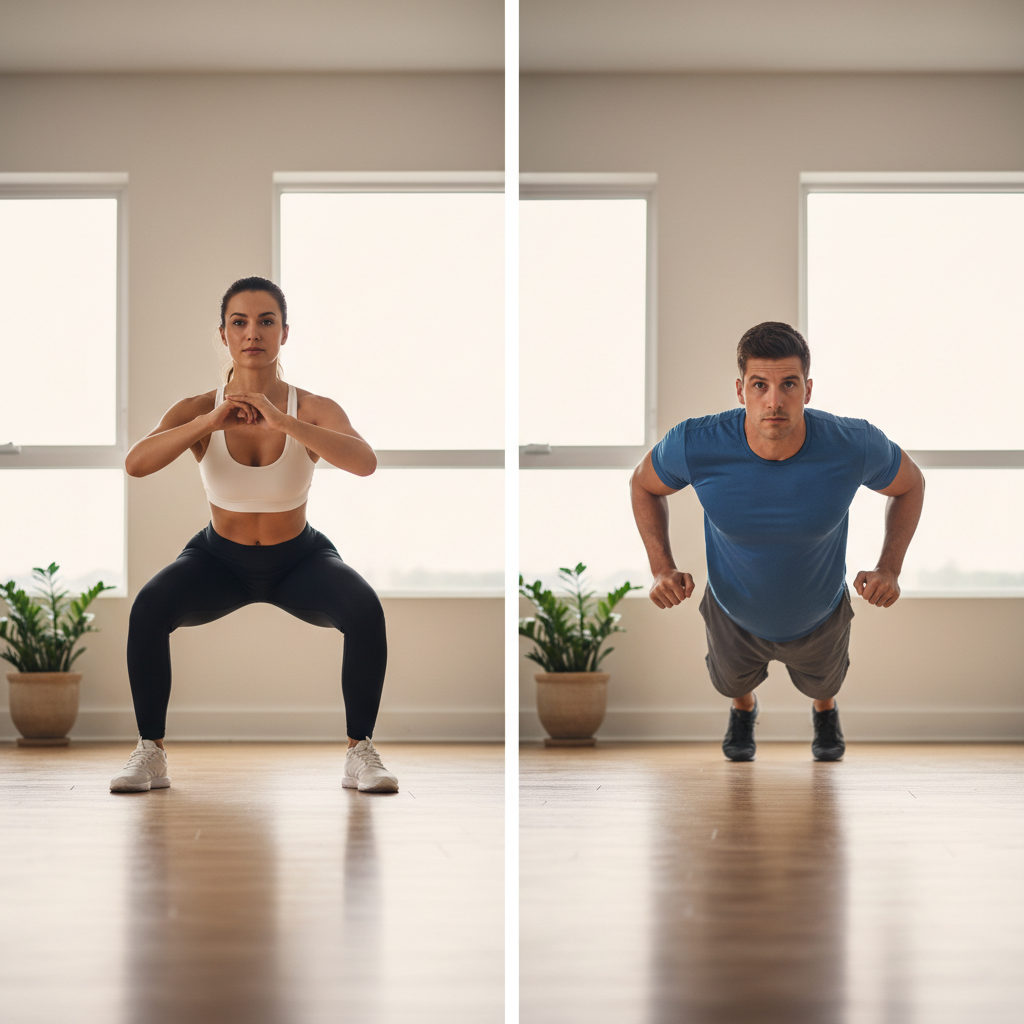
3 no-equipment workouts you can rotate (20–30 minutes)
These are full-body sessions built from the menu above. Pick one, do it well, and repeat it often enough to improve. That repetition is where results usually come from.
Workout A: Full-body strength (steady pace)
- Chair squat or bodyweight squat: 3 sets of 8–15
- Incline push-up: 3 sets of 6–12
- Hip hinge drill or single-leg RDL: 3 sets of 8–12 per side
- Dead bug: 3 sets of 6–10 per side
Rest about 60–90 seconds between sets, stop with 1–3 reps in reserve so form stays clean.
Workout B: Strength + conditioning (short intervals)
- Reverse lunge (or split squat): 8–12 per side
- Push-up variation: 6–12
- Mountain climbers: 20–40 seconds
- Side plank: 20–40 seconds per side
Run 3–5 rounds, rest 60–75 seconds between rounds. If your heart rate spikes and form collapses, slow the tempo, the goal is repeatable quality.
Workout C: Lower-body + core focus (joint-friendly option)
- Glute bridge: 3 sets of 10–20
- Step-back lunge to a shallow depth: 3 sets of 6–10 per side
- Wall sit: 3 sets of 20–45 seconds
- Bird dog: 3 sets of 6–10 per side
This day often feels “too easy” until you slow down and control every rep. That control is the point.
How to progress when you have no weights
A Home Workout gets results when you can make it harder on purpose, not when you randomly add more exercises. Use one or two progression levers at a time.
- Add reps until you hit the top of a range, then switch to a harder variation.
- Slow the eccentric: lower for 3–5 seconds on squats or push-ups.
- Pause 1–2 seconds at the hardest position, bottom of squat, bottom of push-up, top of bridge.
- Add a set only after you can recover well and keep good form.
- Shorten rest slightly, especially for conditioning-focused sessions.
A simple rule that works for many people, if you can do the same workout two sessions in a row with noticeably less effort, it is time to progress one variable.
Weekly plan examples (pick one and keep it boring)
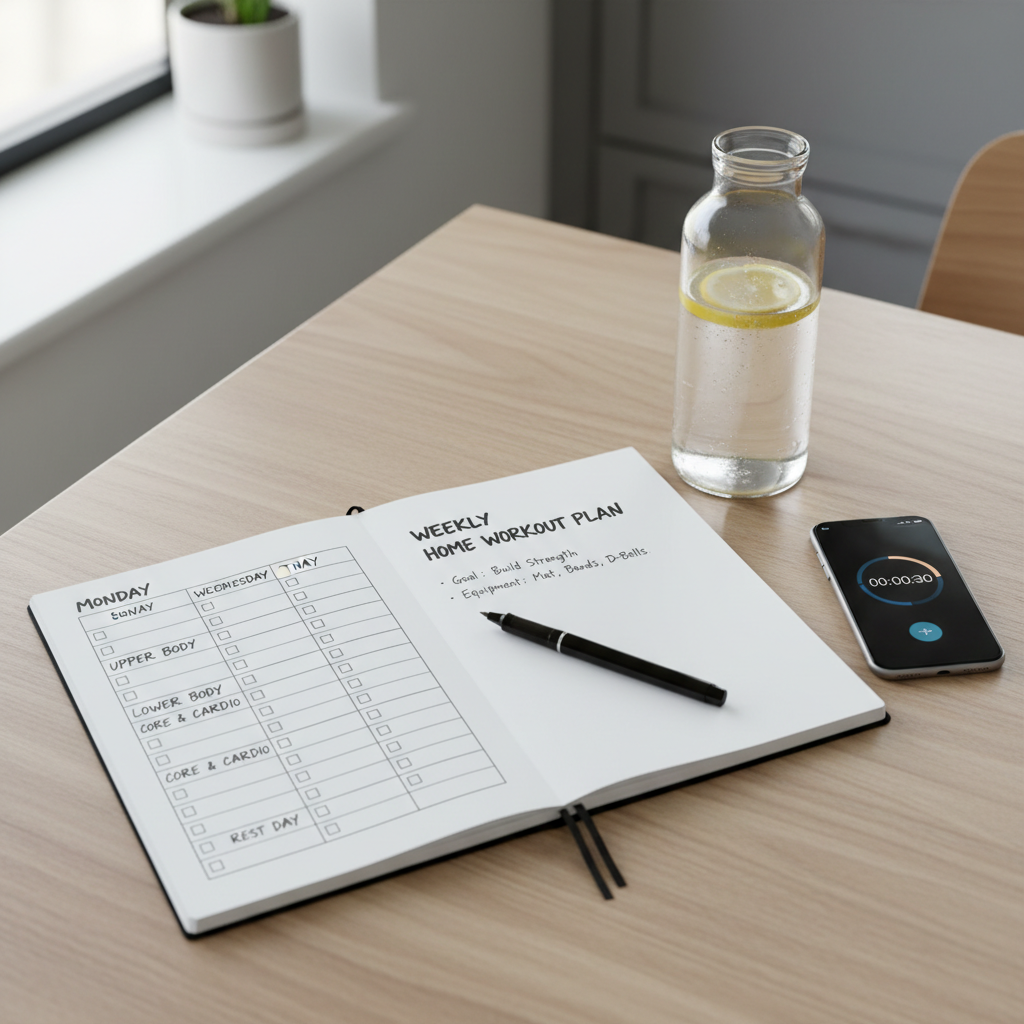
Consistency beats novelty. Choose a schedule that matches your week, then run it for 4–6 weeks before you judge it.
3 days/week (most sustainable)
- Mon: Workout A
- Wed: Workout B
- Fri: Workout C
4 days/week (faster skill and strength)
- Mon: Workout A
- Tue: 20-min brisk walk or light cardio
- Thu: Workout B
- Sat: Workout A (harder variation) + short core finisher
According to the Centers for Disease Control and Prevention (CDC), adults benefit from combining muscle-strengthening activity with aerobic activity across the week. If you dislike “cardio,” walking still counts in many cases.
Common mistakes that make bodyweight plans feel “not working”
Most plateaus are self-inflicted, not because bodyweight training “doesn’t build muscle.” These show up a lot.
- Going to failure every set: it feels hardcore, recovery suffers, technique slips, consistency drops.
- No pulling work: many at-home plans overemphasize push-ups and squats, shoulders start to feel cranky.
- Too many exercises, not enough repetition: you never get better at anything.
- Ignoring sleep and protein: strength gains slow, soreness lingers. According to the Academy of Nutrition and Dietetics, protein needs vary by person and goals, so if you are unsure, a registered dietitian can help.
- “All-or-nothing” scheduling: you miss one day and the week feels ruined, so you quit.
Safety, form, and when to get professional help
A Home Workout should feel challenging, but it should not feel risky. Small tweaks prevent most issues, and when they do not, that is your cue to stop guessing.
- Warm up 3–5 minutes, easy squats, arm circles, hip hinges, light marching, then start the first set easier.
- Use pain rules: sharp pain, numbness, dizziness, or swelling means stop and consider medical advice.
- Protect wrists and shoulders: use an incline for push-ups, keep elbows about 30–45 degrees from your torso, avoid shrugging.
- Respect the low back: slow down hinges, brace your midsection, reduce range of motion if you cannot keep a neutral spine.
If you have a medical condition, are pregnant or postpartum, or are returning after injury, it is smart to check with a clinician or a qualified trainer who can tailor movement choices and progressions.
Key takeaways and a simple next step
If you want a no-equipment plan that sticks, keep your exercise list short, repeat it, and progress one thing at a time. That is the difference between “I tried a Home Workout” and “I train at home.”
- Pick 2–3 workouts and rotate them for at least a month.
- Track one metric per move, reps, tempo, or rest time, then improve it gradually.
- Leave a little in the tank so you can show up again in 48 hours.
Action idea for today, choose Workout A, do one set of each movement as a “test run,” and write down the versions you used so your next session starts with less thinking.
FAQ
Can a Home Workout really build muscle without weights?
It can in many cases, especially for beginners and intermediates, as long as you push close to technical failure and keep progressing with harder variations, tempo, or volume.
How long should a no-equipment session be?
Many people do well with 20–30 minutes. If you can only manage 10–15 minutes, consistency still matters more than a perfect duration.
What if I cannot do a push-up yet?
Start with incline push-ups on a counter or sturdy table, then lower the incline over time. You can also add slow negatives, lowering with control and resetting at the top.
How do I train “pull” muscles at home with no gear?
This is the hardest gap. Some people use towel rows with a safe door setup or table rows if the furniture is stable, but safety matters. If you cannot pull safely, emphasize rear-delt and upper-back work through prone raises and isometric squeezes, and consider adding a simple band later.
Is it okay to work out every day?
It depends on intensity and recovery. Daily low-intensity movement often feels great, but hard strength sessions typically benefit from rest days or alternating muscle groups.
Why am I not sore after these workouts?
Soreness is not a reliable progress marker. If reps, control, or workout density improve over time, that is a better sign you are adapting.
How soon will I see results from a Home Workout?
Many people notice better energy and movement quality within a couple of weeks, while visible physique changes often take longer and vary with sleep, nutrition, and starting point.
What should I do if my knees hurt during squats or lunges?
Try reducing depth, slowing the lowering phase, and using a chair target. If pain persists or worsens, consider professional guidance to rule out technique issues or an underlying problem.
If you are building a Home Workout habit and want a more “done-for-you” routine, it can help to follow a structured program that spells out weekly progressions and substitutions, so you spend less time deciding and more time training.