
5k running training is easiest when you stop guessing and follow a simple, repeatable week-by-week plan that builds fitness without beating up your legs.
If you’ve tried “just run more” and ended up sore, winded, or inconsistent, you’re not alone, most beginners don’t need harder workouts, they need the right progression and enough recovery to adapt.

This 8-week plan keeps things friendly: three runs per week, short “quality” touches like relaxed strides, plus optional strength and mobility that actually help. You’ll also get a quick self-check, pacing rules, and a table you can screenshot.
How this 8-week beginner plan works (and who it fits)
This schedule suits true beginners, returning runners, or anyone who can comfortably walk 30 minutes and wants a structured path to covering 3.1 miles. If you already run 3 miles nonstop, you can still use it, but you may progress faster than the weekly targets.
The rhythm stays consistent: 3 run days, 2 rest or cross-training days, and 2 easy strength/mobility blocks if time allows. Most workouts use run-walk intervals early, then gradually reduce walking as aerobic fitness and connective tissue tolerance improve.
- Easy runs: conversational effort, you could speak in full sentences.
- Intervals: short run segments with walking recovery, still controlled, not “all-out.”
- Long run: slowest day, purely for time on feet and confidence.
According to CDC guidance on physical activity, building up gradually and mixing in muscle-strengthening work helps many people stay healthier and more consistent, especially when starting a new routine.
Before you start: quick self-check and pacing rules
Most problems in 5k running training come from starting too fast, stacking hard days, or ignoring small aches until they become real injuries. Do this quick check before Week 1, it saves frustration later.
Self-check
- You can walk 30 minutes without pain that changes your gait.
- You have shoes that feel stable and not worn flat; if unsure, a running store fit can help.
- You can commit to 3 sessions weekly, even if they’re short.
- If you have heart, breathing, joint, or metabolic conditions, it’s smart to check with a clinician before ramping up.
Pacing rules (simple, but not negotiable)
- Easy pace: you should finish feeling like you could do more.
- Run segments: “smooth” beats “fast.” If you can’t repeat the next interval, you started too hot.
- Talk test: if you can only say 2–3 words at a time, back off.
- Walk breaks: not failure, they’re the tool that keeps weekly volume safe.
The 8-week 5K training plan (3 runs/week)
Use this table as your weekly map. Days can move to fit your life, just avoid placing run days back-to-back when possible. Warm up with 5 minutes brisk walking and finish with 5 minutes easy walking.
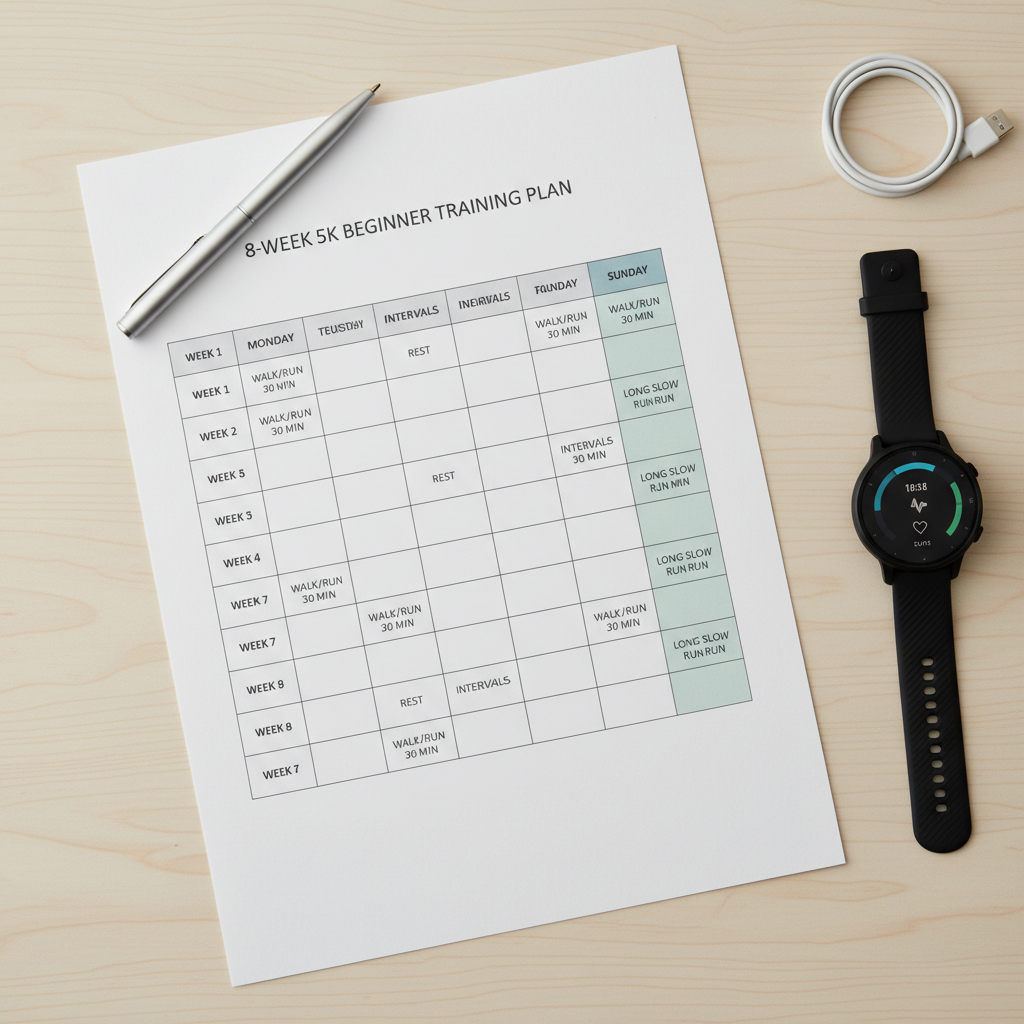
| Week | Run 1 (Intervals) | Run 2 (Easy) | Run 3 (Long/Easy) |
|---|---|---|---|
| 1 | 8 x (1 min run / 2 min walk) | 25 min easy walk-run as needed | 30 min easy (mostly walk is OK) |
| 2 | 6 x (2 min run / 2 min walk) | 25–30 min easy | 35 min easy |
| 3 | 5 x (3 min run / 2 min walk) | 30 min easy | 40 min easy |
| 4 | 4 x (4 min run / 2 min walk) | 30–35 min easy | 45 min easy |
| 5 | 3 x (6 min run / 2 min walk) | 35 min easy | 50 min easy |
| 6 | 2 x (10 min run / 3 min walk) + 5 min run | 35–40 min easy | 55 min easy |
| 7 | 20 min steady run-walk (minimal walking) | 30 min easy + 4 x 20-sec relaxed strides | 35–45 min easy (keep it gentle) |
| 8 | 15–20 min easy + 4 x 20-sec strides | 20–25 min very easy | 5K event or time trial (run-walk allowed) |
Key idea: your “long” day is about time, not speed. If you feel beat up, shorten it by 10 minutes and keep the habit intact.
Common roadblocks (and what’s usually causing them)
When beginners hit a wall, it often looks like motivation, but it’s frequently a pacing or recovery issue. A few patterns show up again and again.
- You feel gassed in the first 5 minutes: early pace too quick, or you skipped the warm-up. Start slower than you think.
- Shin splints or foot soreness: too much too soon, or running on hard surfaces every time. Mix surfaces, shorten intervals, consider a shoe check.
- Knee discomfort: often load management and strength. Keep easy days easy, add simple hip and glute work.
- “I can run in workouts but not nonstop”: normal. Run-walk builds endurance safely, continuous running comes later.
According to American College of Sports Medicine (ACSM), gradual progression and appropriate recovery tend to reduce overuse injury risk for many recreational athletes.
How to make this plan actually work in real life
Plans look clean on paper, real weeks don’t. Here are adjustments that keep your 5k running training moving forward without turning it into a stress project.
If you miss a workout
- Skip it, don’t “make up” two hard sessions back-to-back.
- Return with the next scheduled run, or repeat the previous week if you missed multiple days.
If you feel unusually sore or tired
- Replace Run 2 with a 25–35 minute brisk walk.
- Keep intervals the same but reduce the number of repeats.
- Prioritize sleep and hydration for 48 hours before you decide you “need” new gear.
If you want faster results (without getting reckless)
- Add one extra easy walk day, not an extra run.
- Keep strides relaxed: quick feet, loose shoulders, stop before you strain.

Strength, mobility, and recovery (the underrated part)
If running feels “hard on the body,” a little strength work usually changes the story. Keep it short, keep it consistent, and avoid crushing soreness that ruins your next run.
Twice a week, 15–20 minutes
- Squat to a chair or goblet squat: 2–3 sets of 8–10
- Glute bridge: 2–3 sets of 10–12
- Step-ups (low step): 2–3 sets of 8 each side
- Calf raises: 2–3 sets of 10–15
- Plank or dead bug: 2–3 rounds, controlled breathing
Mobility that tends to help
- Ankles and calves after runs if they feel tight
- Hip flexor stretch if you sit a lot
- Easy foam rolling if it feels good, not as punishment
According to Mayo Clinic, cross-training and strength work can support overall fitness and may help reduce overuse issues for many runners, especially when intensity stays reasonable.
Race week and your first 5K: a calm, practical approach
Your first 5K goes better when expectations stay realistic. The win is finishing feeling proud and healthy, not chasing a time you picked off the internet.
The day before
- Keep food familiar, drink water normally, don’t force extra fluids.
- Lay out shoes and socks you already trust.
- Sleep matters, but one imperfect night rarely ruins a 5K.
Race day pacing that works for beginners
- Start easier than the crowd, the first half-mile should feel almost too controlled.
- Use a run-walk pattern on purpose, for example 3 minutes run / 1 minute walk.
- At the halfway point, reassess: if breathing feels steady, shorten walks a bit.
Key takeaways to remember
- Easy days protect consistency, consistency builds fitness.
- Run-walk is a strategy, not a compromise.
- Small strength work often pays off more than adding miles.
When to pause and get professional help
Some discomfort is normal when you start running, sharp pain and symptoms that change your movement pattern are different. If pain escalates during sessions, lasts several days, or causes limping, consider stopping and checking in with a licensed clinician or physical therapist. If you experience chest pain, dizziness, or unusual shortness of breath, seek medical care promptly.
Conclusion: your next step for the next 8 weeks
You don’t need perfect conditions to follow this plan, you need repeatable weeks and a pace that feels almost boring at first. If you want one action item today, pick your three run days for Week 1 and put them on your calendar, then promise yourself you’ll keep the first run slower than you think you should.
If you finish Week 8 and feel like you still have gas in the tank, that’s a good sign, it means you built a base you can expand safely for a faster 5K later.
FAQ
How many days a week should beginners do 5k running training?
Three run days per week works well for many beginners because it builds fitness while leaving room for recovery. If you add more, make it walking or easy cross-training rather than another hard run.
Is it okay to repeat a week if it feels too hard?
Yes, and it’s often the smart move. Many people progress better by repeating Week 3 or Week 4 than by forcing longer run segments while tired or sore.
What if I can’t run the full 5K by Week 8?
You can still complete the distance using planned run-walk intervals. Finishing a 5K with breaks is still finishing, and it usually sets you up to run more continuously in the next training block.
Should I train by pace, heart rate, or effort?
For most beginners, effort is simplest and surprisingly accurate. If you use heart rate, keep in mind it can drift with heat, stress, caffeine, and poor sleep, so don’t let one number ruin an otherwise good easy run.
What’s the best surface for beginner runners?
Many runners feel better mixing surfaces, like pavement plus packed dirt trails or a track. The “best” option depends on what keeps you consistent and pain-free.
Do I need special shoes for a 5K plan?
You don’t need the most expensive shoe, but you do want a pair that fits well and isn’t worn out. If you have recurring aches, a fitting at a specialty store can be helpful.
Can I do strength training on the same day as running?
Often yes, especially if the run is easy and the strength work stays short. If you notice your legs feel heavy on run days, move strength to a non-run day or reduce the load.
Light next-step (if you want it simpler)
If you’re doing 5k running training and keep getting stuck on pacing, soreness, or how to adjust the plan around work and family, it might help to use a beginner-friendly coaching app or talk with a running coach who can tailor the weekly doses to your schedule and recovery.