
Breathing Technique is one of the fastest ways to influence performance when your body feels “on” but your mind feels scattered, or when nerves hijack your rhythm right before you need to execute.
A lot of people treat breathing as background noise, then wonder why they gas out early, tense up, or lose focus at the worst moment. The tricky part is that “take a deep breath” often makes things worse if you do it at the wrong time or in the wrong way.

This guide breaks down what changes in your body under stress, how to tell which breathing pattern you need, and a few practical drills you can actually remember mid-game, mid-meeting, or mid-set at the gym.
Why breathing changes performance (and why it can backfire)
Breathing isn’t just oxygen in, carbon dioxide out, it’s a control dial for your nervous system. When the dial gets stuck on “high alert,” fine motor control drops, your pacing gets sloppy, and decision-making narrows.
According to the American Psychological Association, slow breathing can help reduce stress responses by shifting the body toward a calmer state. That’s the performance angle: less noise in the system means more usable attention.
- CO2 tolerance: When you over-breathe, you may blow off too much CO2, which can increase lightheadedness and make you feel “amped” but unstable.
- Muscle tension: Fast upper-chest breathing often goes with shoulder/neck tension, not great for running economy, lifting positions, or throwing accuracy.
- Attention control: A repeatable breathing rhythm gives your brain a simple anchor when pressure rises.
One important nuance, breathing exercises may feel uncomfortable at first. If you have asthma, COPD, panic disorder, or any cardiac condition, it’s smart to check with a clinician or respiratory therapist before pushing breath holds or intense drills.
Quick self-check: what’s your current breathing pattern?
Before you pick a drill, you want a quick read on what’s happening. This takes 20 seconds and it’s more useful than guessing.
Two fast tests you can do anywhere
- “Where do I feel the movement?” If most movement is high in the chest/shoulders, you’re likely over-recruiting accessory muscles.
- “Can I exhale smoothly?” If exhale feels short, chopped, or you rush the inhale, your system may be tilted toward fight-or-flight.
If you’re training, also notice whether you habitually breathe through your mouth at low intensity. Mouth breathing has its place, but if it becomes your default during easy efforts, you may be living too close to your redline.
The core breathing techniques (pick the one that matches the moment)
Not every Breathing Technique is designed for the same job. Some calm you down, others help you maintain output without spiking tension, and a few are best kept out of high-stress moments.
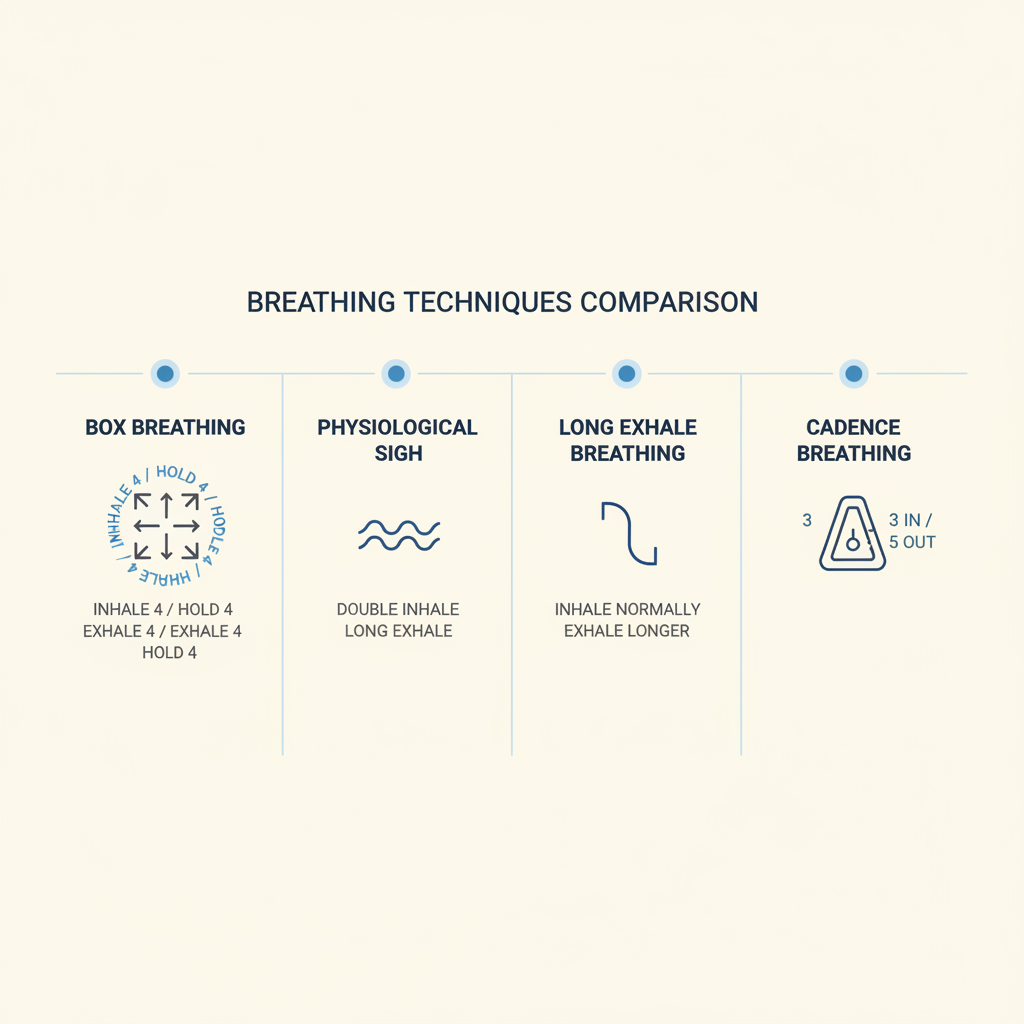
Technique table: purpose, how to do it, when to use
| Technique | Best for | How it feels | Quick cue |
|---|---|---|---|
| Long-exhale breathing | Downshifting nerves, steady focus | Calming, grounded | In 3–4, out 6–8 |
| Box breathing | Pre-performance routine, composure | Structured, centering | In-hold-out-hold, equal counts |
| Physiological sigh | Rapid reset when you feel tight | Immediate release | Double inhale, long exhale |
| Cadence breathing | Running/rowing/cycling rhythm | Efficient, stable pacing | Match breath to steps/strokes |
How to practice (so it shows up under pressure)
The biggest mistake is only practicing breathing when you’re already overwhelmed. You want the pattern familiar enough that it runs in the background while you perform.
A simple weekly plan (10 minutes a day)
- Days 1–3: Long-exhale breathing, 5 minutes. Keep inhale quiet and nasal if possible.
- Days 4–5: Box breathing, 4 minutes, then 2 minutes normal breathing while staying relaxed in the shoulders.
- Days 6–7: Add light movement: walk and keep a steady inhale/exhale ratio without gasping.
According to the National Institutes of Health, slow breathing practices can influence autonomic function, which is part of why consistency matters more than intensity. If you only dabble, you’ll still benefit, but it may not be reliable in high-stakes moments.
Sport and training scenarios: what to do in the moment
This is where people want the “one magic drill.” Reality check: use the smallest tool that works for the situation, and don’t overcomplicate it.
Before a lift, sprint, serve, or shot
- Try one physiological sigh, then one quiet nasal inhale and long exhale.
- Keep your jaw unclenched, tongue resting gently on the roof of the mouth.
- If you feel dizzy, stop forcing deep inhales and return to normal breathing.
During endurance work (running, cycling, rowing)
- Use cadence breathing: for example, inhale for 3 steps, exhale for 3–4 steps at easy/moderate intensity.
- If pace rises, shorten counts without switching to frantic breathing.
- Check posture: ribcage stacked over pelvis often makes breathing feel easier immediately.
Between sets or during timeouts
- Do 3–5 rounds of long-exhale breathing to drop unnecessary tension.
- Use one simple cue: “Slow out-breath.” It’s easier than counting under fatigue.
Work, speaking, and mental performance: staying sharp without getting flat
Performance isn’t only athletic. If your voice shakes on calls, you rush through presentations, or your hands feel clumsy when you’re stressed, breathing is often part of the pattern.

Two small routines that work in real life
- Before you speak: inhale gently through the nose for about 3 seconds, exhale for about 6 seconds, repeat 3 times, then start talking on a normal breath.
- When you feel cognitive overload: one physiological sigh, then look at one object and describe it silently for 10 seconds, this pairs breathing with attentional control.
One subtle win: a calmer breath often makes your voice steadier because you’re not fighting to get air at the end of sentences. That’s not “breathwork magic,” it’s just mechanics.
Common mistakes and safety notes (so you don’t waste time)
- Overdoing deep breathing: If you keep taking huge inhales, you may trigger lightheadedness. Smaller, quieter inhales often work better.
- Breath holds under stress: Some people hold their breath when concentrating, which spikes tension. If that’s you, practice exhaling during effort.
- Forcing nasal breathing at all costs: Nasal breathing is helpful in many cases, but congestion, asthma, or high intensity may require mouth breathing. Use what keeps you stable.
- Expecting instant transformation: A Breathing Technique can help quickly, but performance gains usually come from pairing it with training, sleep, and recovery.
If breathing drills consistently trigger panic sensations, wheezing, chest pain, or faintness, stop and consider talking with a qualified healthcare professional. That pattern can have multiple causes, and pushing through often backfires.
Key takeaways you can use today
- Match the drill to the moment: long exhale for calm, cadence for endurance rhythm, physiological sigh for quick reset.
- Practice when you’re fine: that’s what makes it show up when you’re not.
- Keep it simple under pressure: one cue beats a complicated count every time.
If you want a starting point, do 5 minutes of long-exhale breathing daily for a week, then add one “in-the-moment” tool such as the physiological sigh during training or stressful work moments and see what actually changes.
FAQ
What is the best Breathing Technique for anxiety before competition?
Many people do well with long-exhale breathing because it downshifts arousal without making you feel sleepy. If you need a fast reset, one physiological sigh can be enough, then return to normal breathing.
How long does it take for breathing drills to improve performance?
You might feel a difference the first time, but reliability usually takes repetition. A week of short daily practice often makes the technique easier to access when pressure spikes.
Is box breathing good for athletes?
It can be, especially as a pre-performance routine or between rounds. During very high-intensity efforts, equal holds may feel restrictive, so many athletes switch to a simple long exhale instead.
Should I breathe through my nose or mouth during training?
Nasal breathing works well at low to moderate intensity for many people, but it’s not a rule. If nasal breathing creates distress or you have respiratory conditions, mouth breathing may be more appropriate, consider medical guidance if unsure.
Can a Breathing Technique help with focus at work?
Often, yes. Slow, controlled exhale patterns can reduce the “wired” feeling and make it easier to stay on one task, especially before a presentation or a difficult conversation.
Why do I get lightheaded when I try deep breathing?
It may be a sign you’re over-breathing or breathing too quickly. Try smaller inhales, longer exhales, and pause the exercise if symptoms persist.
Are breath holds safe for everyone?
Not always. Breath holds can be risky for people with certain medical conditions and can provoke panic symptoms in some individuals, so it’s best to be cautious and consult a professional if you want to train them seriously.
What’s an easy breathing routine I can remember in the moment?
Try this: inhale quietly for a count of 3, exhale for a count of 6, repeat three times. If you forget the counts, just keep the out-breath slower than the in-breath.
If you’re practicing and still feel stuck, like your breathing collapses every time intensity rises, you might benefit from a coach, physical therapist, or clinician who can spot mechanical issues such as bracing, posture habits, or dysfunctional breathing patterns and tailor a plan without guesswork.